Materials for Vacuum Technology: Specialty Metals and Materials for HV, UHV, and XHV
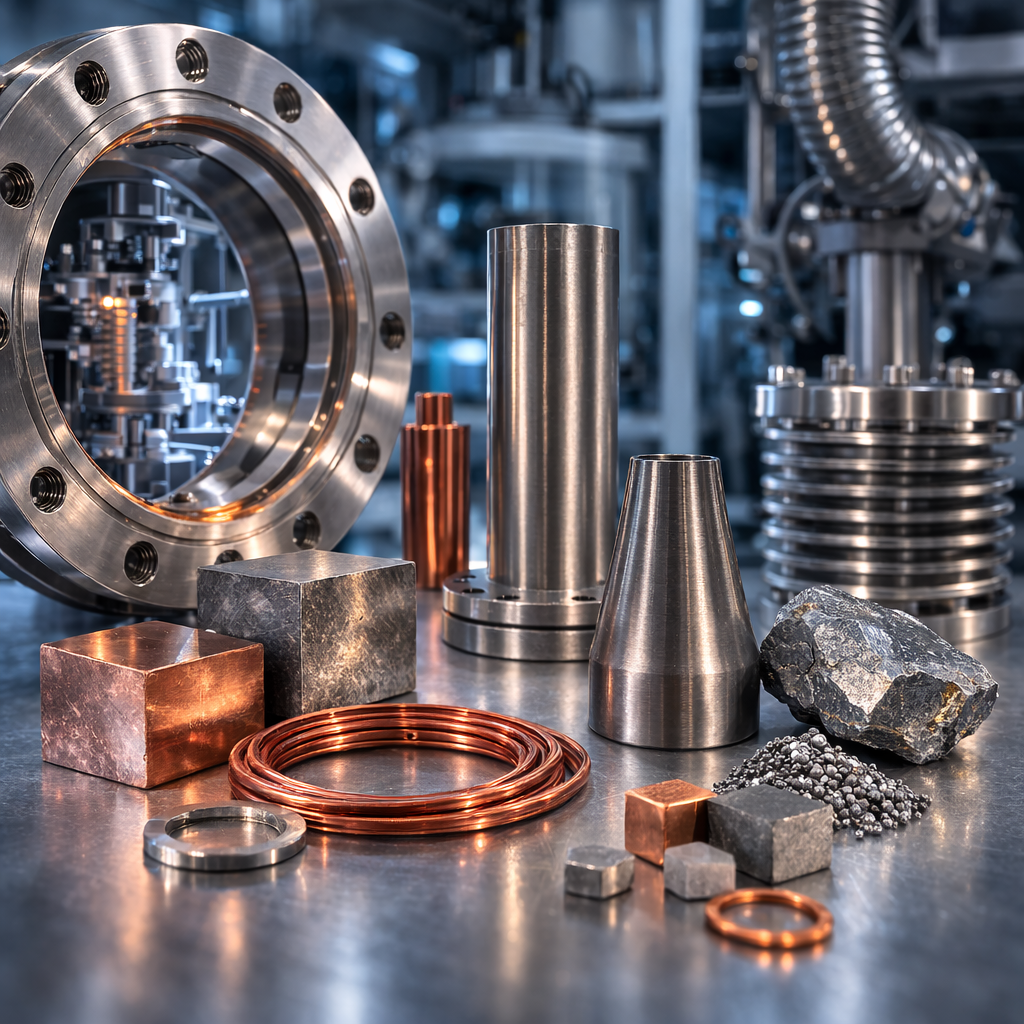
In vacuum technology, it is not enough to classify materials simply as “vacuum-compatible” or “not vacuum-compatible.” What matters are the actual operating conditions: vacuum range, temperature, residual gas behavior, corrosion exposure, magnetic properties, cleanliness level, sealing concept, and manufacturing route.
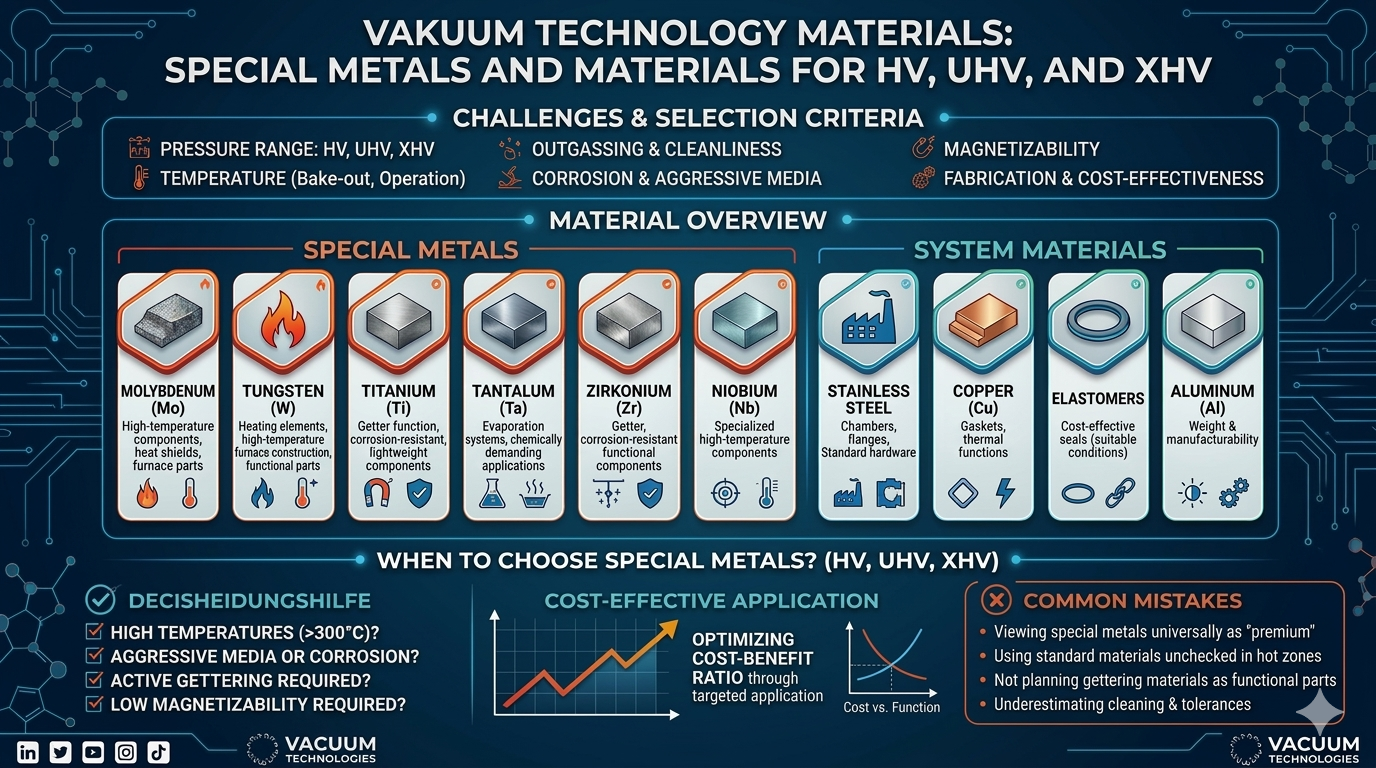
For many standard components, stainless steel, copper, and suitable sealing materials remain essential. However, as soon as high temperatures, aggressive media, getter function, or specific requirements regarding chemical resistance and material behavior come into play, specialty metals become significantly more important. This is exactly where materials such as molybdenum, tungsten, titanium, tantalum, zirconium, and niobium become technically relevant.
These materials are not important in vacuum technology because they are rare or especially demanding. They are used because they solve specific technical challenges: high thermal stability, strong high-temperature performance, low thermal expansion, corrosion resistance, defined physical properties, or getter behavior.
A technically sound article on materials for vacuum technology should therefore not only describe standard materials, but above all answer one key question: When are specialty metals the right choice from a design, manufacturing, and economic perspective?
Questions to consider
- Which vacuum range is actually required: HV, UHV, or XHV?
- Are you dealing with structural components, heat shields, evaporation components, feedthroughs, getters, or functional internal parts?
- What temperatures occur during operation or bake-out?
- Are corrosive media or process-related chemical loads relevant?
- Is low magnetic permeability required?
- Which tolerances, surface finishes, and inspection requirements are functionally necessary?
Requirements for materials in vacuum technology
Low outgassing and clean surfaces
Outgassing describes the release of gases from the surface or bulk of a material. In vacuum systems, material condition, cleaning, pretreatment, and surface quality directly affect the achievable pressure. The more demanding the vacuum level, the more important clean, controlled, and reproducible surfaces become.
Temperature resistance and dimensional stability
In many vacuum applications, components are subjected to high thermal loads or are intentionally heated during bake-out. Materials must retain their shape, function, and stability under these conditions. High-melting metals such as molybdenum, tungsten, tantalum, or niobium are therefore particularly relevant in hot zones, furnace applications, and thermally stressed internal components.
Corrosion resistance
Even under vacuum conditions, chemically demanding processes, aggressive media, or residual substances can play an important role. In such applications, it is not vacuum compatibility alone that matters, but also resistance to the actual process conditions. Titanium, tantalum, and zirconium are often attractive material options here.
Magnetic properties
In certain measuring, analytical, or research applications, magnetic interference must be minimized. In these cases, selecting a “standard” material is often not sufficient. The magnetic properties of the material need to be considered from the outset.
Mechanical strength and manufacturability
Materials for vacuum technology must not only be physically and chemically suitable, but also manufacturable in a reliable way. This includes machinability, weldability, dimensional stability, low internal stress, and economic availability. A technically suitable material is only a good solution if it can also be implemented in a component-ready design.
Which specialty metals are particularly relevant for vacuum technology?
Molybdenum
Molybdenum is particularly relevant in vacuum technology wherever high temperatures, good thermal conductivity, and low thermal expansion are required. Typical applications include thermally stressed internal components, heat shields, furnace parts, or function-critical components in high-temperature processes.
Tungsten
Tungsten is the material of choice for extremely high thermal loads. Its very high melting point and high density make it particularly attractive for heating elements, high-temperature furnace construction, electrical functional parts, and specialized vacuum applications.
Titanium
In vacuum technology, titanium is relevant both as a corrosion-resistant structural material and as a functional material. It becomes especially important wherever low density, chemical resistance, or getter properties are required.
Tantalum
Tantalum is particularly attractive for vacuum applications when high corrosion resistance and high temperature stability are required at the same time. Typical areas of use include chemically demanding applications, evaporation systems, and thermally stressed process zones.
Zirconium
Zirconium is not a universal standard material, but a function-oriented material used selectively. In vacuum technology, it is especially relevant wherever corrosion-resistant components or getter materials are required.
Niobium
Niobium is of interest for specialized vacuum applications when high temperature resistance, good workability, and defined material properties are needed. It is mainly considered when standard solutions no longer meet the functional requirements.
Complementary system materials
A complete technical article on materials for vacuum technology should also include the system materials that remain indispensable in many applications:
- Stainless steel for chambers, flanges, and many standard components
- Copper especially for metal seals
- Elastomers for suitable sealing applications within the appropriate pressure and temperature range
- Aluminum where low weight and machinability are the main priorities
These materials form the basis of many systems. Specialty metals take over where standard materials reach their limits and function-critical requirements begin.
Material overview for vacuum technology
Material | Typical role in vacuum technology | Classification |
Molybdenum | High-temperature components, heat shields, thermally stressed internals | Specialty metal |
Tungsten | Heating elements, high-temperature applications, functional parts | Specialty metal |
Titanium | Getters, corrosion-resistant components, lightweight parts | Specialty metal |
Tantalum | Evaporation systems, chemically stressed areas | Specialty metal |
Zirconium | Getters, corrosion-resistant functional components | Specialty metal |
Niobium | Specialized components for high temperatures and defined requirements | Specialty metal |
Stainless steel | Chambers, flanges, standard hardware | System material |
Copper | Seals, thermal functions | System material |
Elastomers | Economical sealing solutions in suitable applications | System material |
Material selection by component
Function-critical internal components
For heat shields, radiation shields, areas near evaporation sources, or components exposed to high thermal loads, specialty metals such as molybdenum, tungsten, or tantalum are often the technically better choice. In these cases, the key factor is not raw material cost alone, but process reliability.
Getter and residual gas functions
Titanium and zirconium are especially relevant where materials are not only used structurally, but also actively contribute to residual gas binding. In such applications, they are not simply an alternative to standard materials, but targeted functional materials.
Structural custom components
Niobium, titanium, tantalum, or molybdenum can also be the right choice for custom components and engineered parts when temperature, media, corrosion, or physical requirements limit the use of conventional materials.
DFM and cost efficiency
Material selection in vacuum technology is always also a question of manufacturability and cost efficiency. The goal is not to use the most sophisticated material possible, but to implement the functionally correct solution in a clean and practical way.
In most cases, the economically sound approach is to:
- use specialty metals only where they provide a clear functional advantage
- limit expensive materials to the actual function-critical zones
- design geometries so that machining, stress input, and distortion remain controllable
- define surface finish, cleanliness, and inspection requirements early
- consider material availability already during the design phase
Practical question
Do you really need a complete assembly made from specialty metal — or only selected function-critical components made from molybdenum, tungsten, titanium, tantalum, zirconium, or niobium?
Common mistakes in material selection
Typical mistakes in vacuum technology include:
- classifying specialty metals as “premium materials” without evaluating their actual function
- applying standard materials in hot or chemically stressed process zones without verification
- failing to treat getter materials as dedicated functional elements
- evaluating sealing concept, material selection, and bake-out separately instead of together
- underestimating cleanliness, cleaning, and packaging requirements
- tightening tolerances and surface finish requirements unnecessarily without functional benefit
Conclusion
Materials for vacuum technology can only be evaluated properly in the context of the actual application. Vacuum range, temperature, media, sealing concept, surface condition, and manufacturing route must always be considered together.
Stainless steel, copper, and suitable sealing materials remain indispensable for many systems. However, once high temperatures, getter functions, chemical resistance, or specific physical properties become critical, specialty metals come into play. This is where molybdenum, tungsten, titanium, tantalum, zirconium, and niobium offer technical advantages that standard materials cannot provide in the same way.
Checklist for your inquiry
The following information is especially helpful for a well-founded material assessment:
- vacuum range and application
- media and temperature profile
- drawing, sketch, or functional description
- required surface finish and cleanliness requirements
- sealing concept and installation situation
- quantity and inspection scope
A reliable material decision is not based on generic approvals, but on a clear technical understanding of the application. That is the key lever for functional reliability, cost efficiency, and a design that is ready for manufacturing.
Material Overview for Vacuum Technology